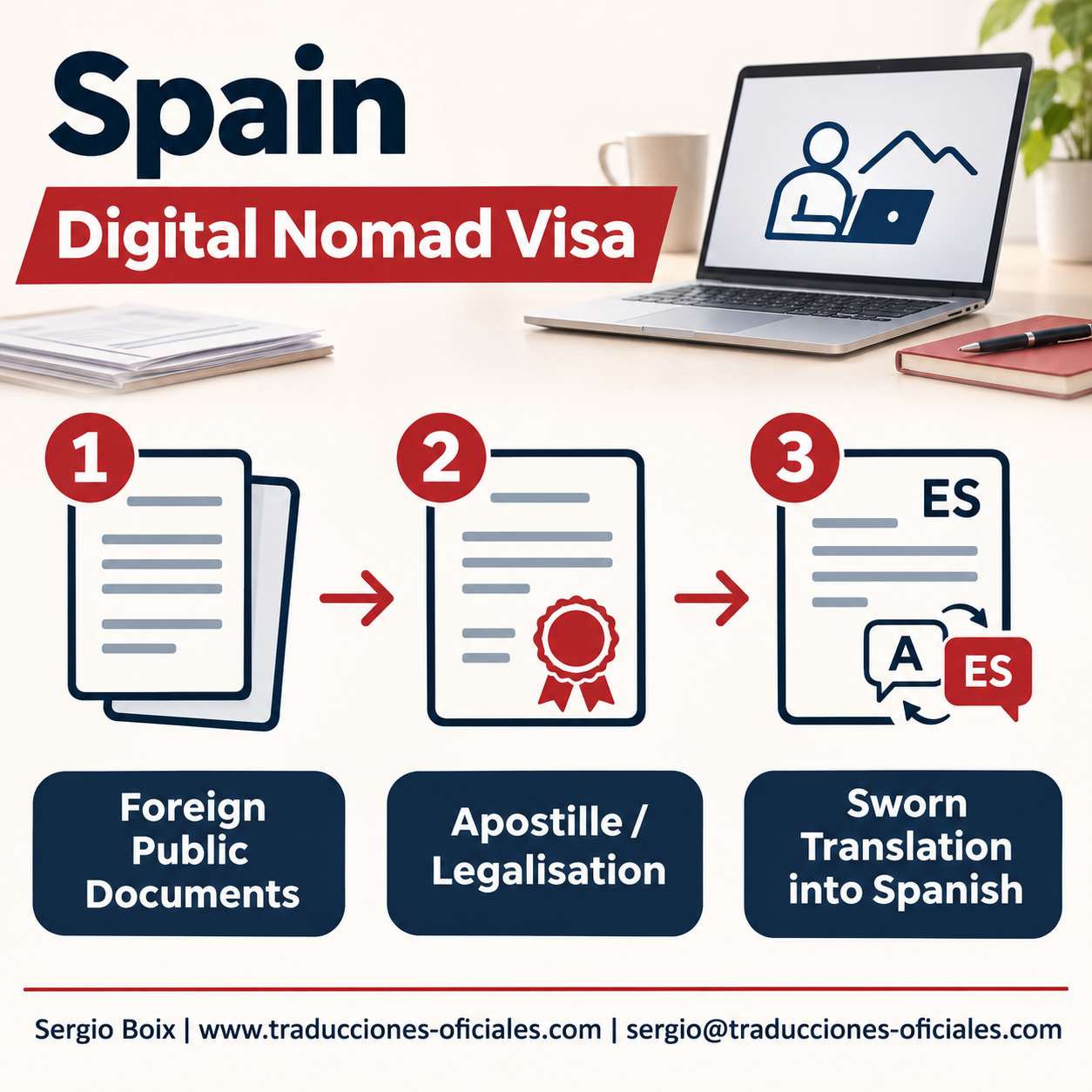
Applying for Spain’s international telework residence authorisation often involves documents issued outside Spain. The practical question is not only whether a document needs an apostille or legalisation, but also whether the receiving authority expects an official translation into Spanish.
This checklist is a practical starting point for English-language documents. Requirements can depend on the document, the applicant’s route and the authority reviewing the file. Always check the current official checklist before submitting.
1. Identify the documents that may need translation
The UGE documentation guide for international teleworkers lists items such as the employment or professional relationship, evidence concerning the foreign company, financial records, professional qualifications or experience, social-security documents, criminal-record certificates and health-insurance evidence. Not every item follows the same translation route, so sort the file document by document.
2. Check apostille or legalisation first
For foreign public documents, the Spanish immigration guidance explains that the document may need a Hague Apostille or diplomatic legalisation, unless an applicable treaty or agreement provides an exemption. Confirm which authority issues the apostille or legalisation in the country of origin.
3. Order the Spanish translation in the right format
The Ministry of Inclusion states that public documents not written in Spanish should be accompanied by a translation made by a sworn translator authorised by Spain’s Ministry of Foreign Affairs, European Union and Cooperation. The same guidance describes limited alternatives involving Spanish diplomatic missions or consular offices, subject to their own formalities.
4. Build a document checklist before sending files
- Document name and issuing country.
- Whether it is a public document or a private/business document.
- Whether the receiving authority asks for an apostille or legalisation.
- Whether the complete document, annexes and stamps are included.
- Whether the authority accepts an electronic sworn translation or requests paper.
- The exact language direction: English to Spanish, or another permitted route.
5. Use the official sources
Read the current UGE teleworkers page and its documentation guide for holders. For general immigration document formalities, consult the Ministry’s legalisation and translation guidance and the Ministry of Foreign Affairs information on legalisation and Apostille.
A practical next step
Before ordering a translation, send the complete document, including seals and annexes, and identify the Spanish authority or procedure involved. I can confirm the estimated cost and turnaround time for English–Spanish sworn translation once I can review the file.
Note: This article is general information, not a definitive legal assessment. The receiving authority’s current checklist takes priority.